The Bessemer Era: Industrialising Steel for Mass Consumption
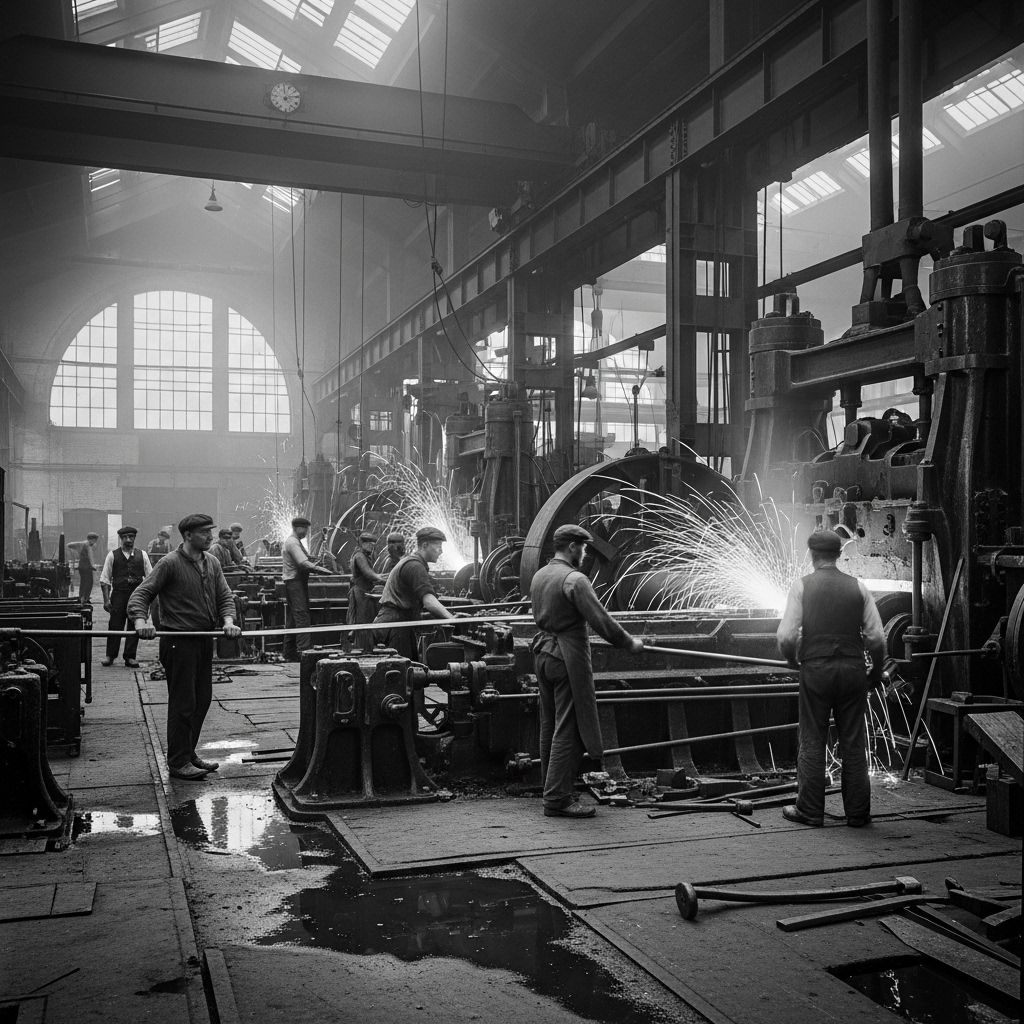
The history of automotive metallurgy cannot be separated from the broader history of steel production. When Henry Bessemer patented his converter process in 1856, he introduced a method for producing large quantities of low-cost steel from pig iron by blowing cold air through the molten metal to oxidise carbon impurities. Within a decade, Bessemer steel had transformed shipbuilding, railway infrastructure, and construction — and laid the material groundwork for the nascent automobile industry that would emerge in the 1880s.
The earliest motor carriages, produced in limited numbers by pioneers such as Karl Benz and Gottlieb Daimler, were constructed primarily from wrought iron and low-carbon mild steel. These materials were chosen not for their ideal mechanical properties but for their availability, weldability, and established manufacturing infrastructure. Frame members were typically formed by hand, forged over anvils, and bolted together in a manner directly inherited from carriage-making traditions. The science of materials selection, in any rigorous sense, had yet to arrive.
By the turn of the twentieth century, however, improvements in the open-hearth furnace process allowed metallurgists to exercise finer control over the carbon content and alloy composition of steel. This control proved decisive: lower carbon content produced steels that were more ductile and easier to press into complex shapes, enabling early body panel fabrication. Higher carbon grades, reserved for chassis members and mechanical components, offered the tensile strength required to withstand road loading over extended distances.
The Rise of Body-on-Frame Architecture and Pressed Steel
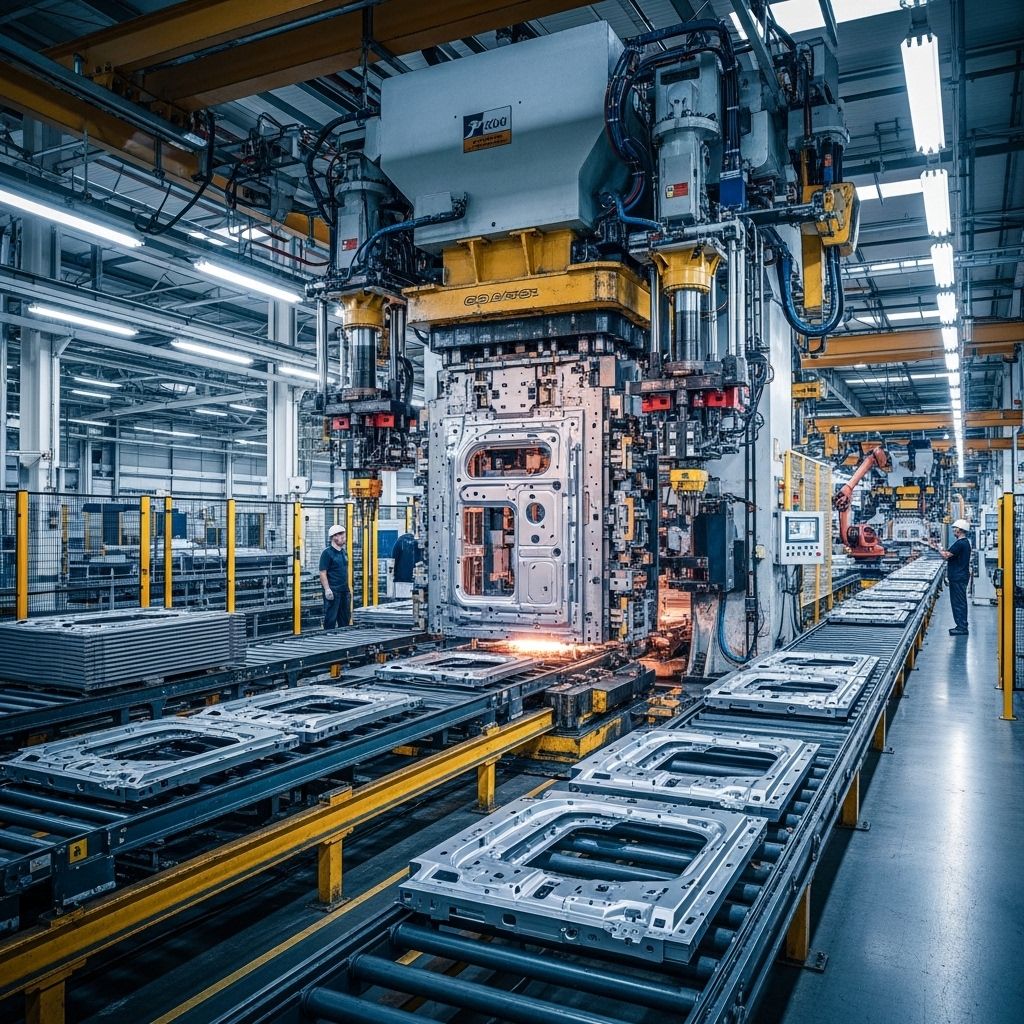
Between 1900 and 1930, the industrialisation of vehicle production — driven above all by Ford's moving assembly line, introduced at the Highland Park plant in 1913 — transformed the economics and engineering of automotive metalwork. The requirement for identical, interchangeable components at volume could only be satisfied by mechanical forming processes: stamping, pressing, and drawing sheet steel between hardened dies.
Pressed steel body panels were not merely a production convenience; they represented a fundamental engineering achievement. A single press stroke could form a compound-curved surface — a door skin, a bonnet pressing, a wing section — that would have required hours of hand-beating in earlier practice. The material enabling this shift was cold-rolled low-carbon steel (SPCC grade), whose combination of surface quality, ductility (typically 28–38% elongation at break), and consistent thickness tolerances made it the default material for automotive body sheet through most of the twentieth century.
Body-on-frame construction, in which separate steel frames carried the structural loads and body panels were mounted non-structurally on top, dominated the industry until the 1950s. This separation of structural and aesthetic functions had direct metallurgical implications: frame steel required high yield strength, while body steel required high formability. The two needs were met by specifying different alloy grades — an early example of deliberate materials engineering in automotive design.
Unibody Construction and the Demands of Structural Integration
The development of unibody (monocoque) construction — in which the body shell itself carries structural loads, eliminating the separate chassis — introduced considerably more complex metallurgical demands. Without a dedicated load-bearing frame, every section of the body shell must contribute to the overall structural integrity of the vehicle. Floor pans, sill members, roof rails, and pillar sections must all be engineered to manage torsional stiffness, bending loads, and — with increasing regulatory emphasis from the 1960s onward — crash energy absorption.
This structural integration requirement drove the development of distinct steel grades optimised for different zones of the vehicle. Mild steel remained appropriate for outer skin panels where complex forming was required, but inner structural members began to employ higher-strength steels with yield strengths of 300–500 MPa. The science of zone-specific material selection — now codified as tailored blank technology — was beginning to take shape.
By the 1970s, the introduction of dual-phase steels represented a significant advance in automotive metallurgy. Dual-phase steels contain a microstructure consisting of hard martensite islands dispersed within a ductile ferrite matrix, achieved through carefully controlled heat treatment cycles. This two-phase microstructure simultaneously delivers high tensile strength and good elongation — a combination previously considered contradictory in conventional steel grades. Dual-phase and, subsequently, transformation-induced plasticity (TRIP) steels became foundational to modern automotive structural engineering.
The Aluminium Transition: Lightweighting and Lifecycle Engineering
From the mid-1990s onward, the aluminium alloy emerged as a genuine structural competitor to steel in automotive applications. Driven by fuel economy legislation and the development of increasingly capable aluminium forming technologies, manufacturers began substituting aluminium for steel in bonnets, door structures, and — in landmark cases such as the Audi A8 (1994) and later the Jaguar XJ (2003) — entire body structures.
Aluminium's principal advantage over steel is its density: at 2.70 g/cm³ compared to steel's 7.85 g/cm³, aluminium structures can achieve equivalent stiffness at approximately 40–50% lower mass, depending on design. The material penalty, however, lies in its elastic modulus: at 69 GPa versus steel's 200 GPa, aluminium is approximately three times less stiff per unit cross-section. Structural equivalence therefore requires changes to section geometry — thicker gauges, closed sections, and greater material volume — which partially offset the density advantage.
The alloys selected for automotive structural applications are predominantly from the 5xxx (aluminium-magnesium) and 6xxx (aluminium-magnesium-silicon) series. The 6xxx series, solution heat-treated and artificially aged to T6 temper, offers a yield strength of approximately 276 MPa with good corrosion resistance and weldability — making it the dominant choice for extruded structural components. The 5xxx series, preferred for outer skin panels, offers superior formability in the annealed condition, with the natural work hardening during forming providing additional service strength.
Advanced High-Strength Steels and the Era of Multi-Material Architecture
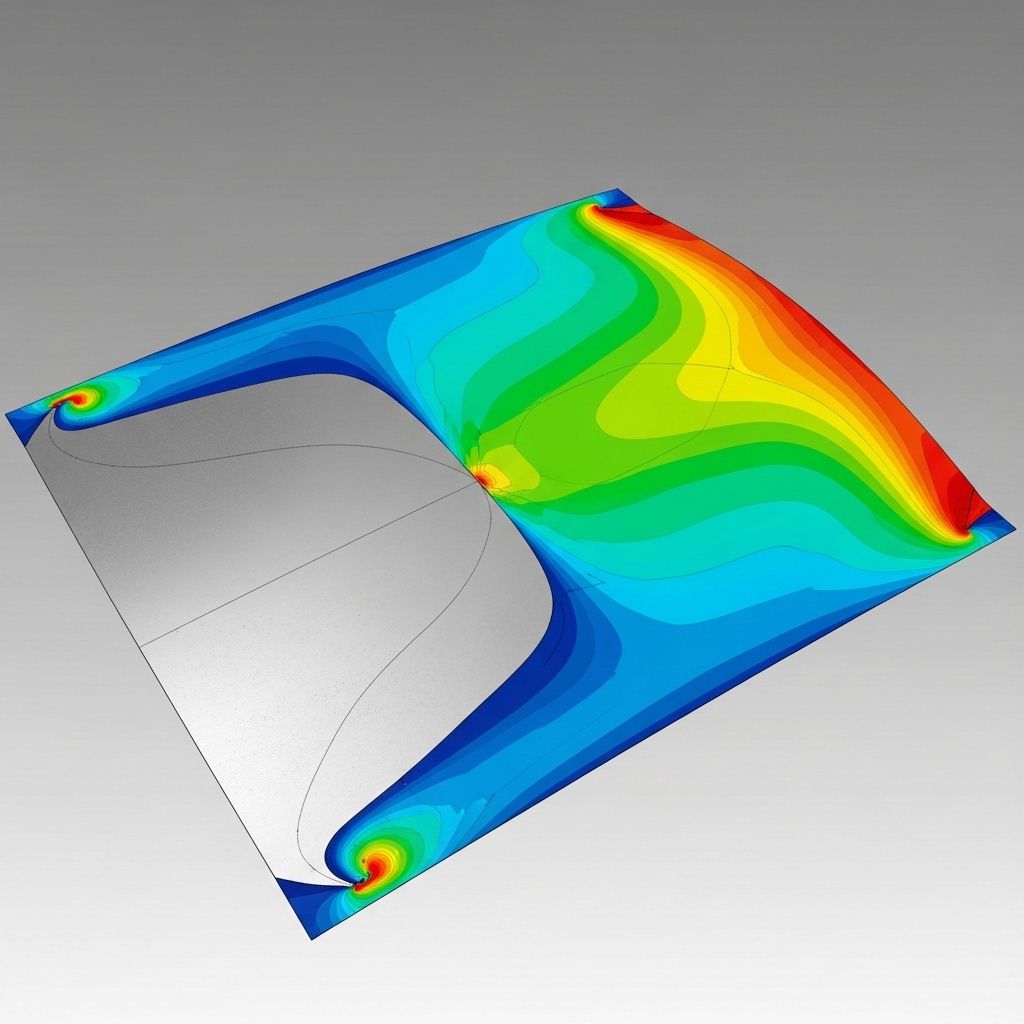
The contemporary automotive body structure is rarely fabricated from a single material. Modern vehicles employ what engineers term multi-material architecture: a deliberate combination of advanced high-strength steel (AHSS), conventional mild steel, aluminium alloy, and — in the highest-performance applications — carbon fibre reinforced polymer (CFRP). Each material is placed precisely where its properties are most advantageous, guided by finite element analysis and topology optimisation tools.
Advanced high-strength steels, including press-hardened steels (PHS) such as 22MnB5 — heated to 900°C and rapidly quenched in the die to develop a full martensite microstructure with yield strengths exceeding 1,000 MPa — are now standard in A and B pillars, door rings, and cross-members. Their extraordinary strength allows for very thin gauge usage in these safety-critical zones, with important mass savings relative to earlier mild steel equivalents.
The result, across 130 years of development, is a materials science discipline of considerable sophistication. What began as the practical application of available blacksmithing materials has evolved into a precision-engineered system of alloy selection, thermomechanical processing, and structural topology — driven by competing demands of mass, strength, formability, cost, corrosion resistance, and recyclability.
Continue exploring the science of automotive metals — take the interactive metallurgy assessment or read the next article in the research archive.