The Crystal Lattice: Foundation of Metallic Behaviour
All metallic materials, including the steels and aluminium alloys used extensively in vehicle construction, derive their mechanical properties from the regular, repeating atomic arrangement known as the crystal lattice. In the case of iron — the primary constituent of steel — atoms are arranged in either a body-centred cubic (BCC) structure at room temperature or a face-centred cubic (FCC) structure above 912°C. This distinction is not merely academic: the packing density and inter-atomic bond geometry of these structures directly determine properties such as ductility, yield strength, and the capacity for elastic recovery.
Within a crystal lattice, each atom is bound to its neighbours by metallic bonds — a delocalised electron cloud shared across the entire lattice that provides both strength and electrical conductivity. When an external mechanical force is applied, the inter-atomic spacing is altered: atoms are displaced from their equilibrium positions, increasing or decreasing bond lengths and angles throughout the affected zone. Provided these displacements remain within a critical threshold, the elastic restoring force of the lattice bonds is sufficient to return every atom to its equilibrium position upon removal of the load. This is the atomic-scale definition of elastic deformation.
Hooke's Law and the Macroscopic Expression of Lattice Elasticity
At the macroscopic engineering scale, the elastic behaviour of metals is described by Hooke's Law — the linear relationship between applied stress (σ) and resulting strain (ε), mediated by the material's Young's Modulus (E): σ = Eε. Young's Modulus is a direct physical expression of the stiffness of inter-atomic bonds within the lattice. For mild steel, E = 200 GPa; for aluminium alloy 6061, E = 69 GPa. The approximately threefold difference reflects the greater electron density and stronger bonding character of the iron lattice relative to aluminium.
Hooke's Law holds with precision across the elastic range but breaks down entirely beyond the yield point — the stress at which permanent lattice changes begin. In mild steel, this transition is marked by a distinct upper yield point followed by a lower yield point, a feature that arises from the interaction of solute atoms (predominantly carbon and nitrogen) with dislocations in the lattice. At the moment of yielding, pinned dislocations break free from their solute atmospheres and propagate through the crystal, producing macroscopic permanent strain at essentially constant applied stress — the Lüders band phenomenon visible in tensile test specimens as a propagating front of localised deformation.
Dislocations: The Agents of Permanent Deformation
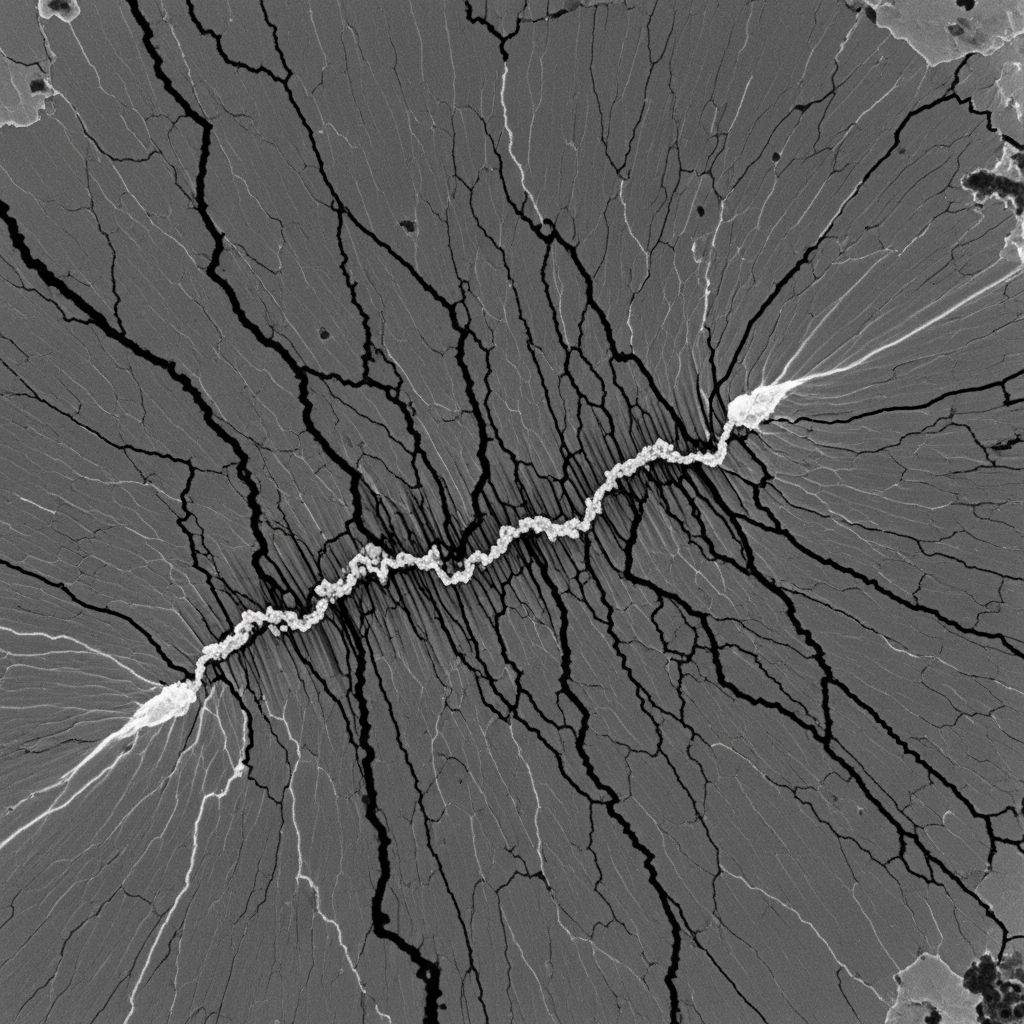
The concept of the dislocation is central to understanding why metals deform permanently when stressed beyond their elastic limit. A dislocation is a linear defect within the crystal lattice — a misalignment of atoms along a line that allows plastic deformation to occur at stresses far lower than the theoretical shear strength of a perfect crystal. Without dislocations, metals would be approximately 1,000 times stronger but completely brittle. Their presence enables ductility by providing a low-energy mechanism for shear deformation: rather than breaking all bonds simultaneously across a plane, the lattice shifts one atomic row at a time as the dislocation moves.
The density and mobility of dislocations are the primary determinants of a metal's yield strength. A freshly annealed (softened) steel contains a dislocation density of approximately 1010 to 1012 dislocations per square metre. As the material is deformed plastically, dislocation density increases by several orders of magnitude — dislocations multiply, interact, and entangle, creating a network that increasingly resists further dislocation movement. This self-reinforcing resistance is the physical basis of work hardening, or strain hardening: the well-established observation that metals become progressively stronger and harder as they are plastically deformed.
Molecular Memory: Recording Deformation in the Microstructure
The phrase molecular memory, while evocative, refers to a specific and well-characterised physical phenomenon: the retention of deformation history within the microstructure of a metal. When a metallic component is deformed beyond its elastic limit, the resulting changes in dislocation density, grain orientation, and residual stress state are preserved in the microstructure indefinitely — unless erased by sufficient thermal energy in the form of an annealing treatment.
This encoded history influences all subsequent mechanical responses of the material. A steel component that has experienced prior plastic deformation will exhibit a different yield behaviour under a second loading event than an identical, undeformed specimen. Specifically, pre-deformed steel typically shows a higher initial yield strength (due to increased dislocation density) but reduced ductility (due to reduced capacity for further dislocation multiplication before fracture). In the context of cyclically loaded automotive structural components, this accumulated deformation history is a critical factor in fatigue life prediction.
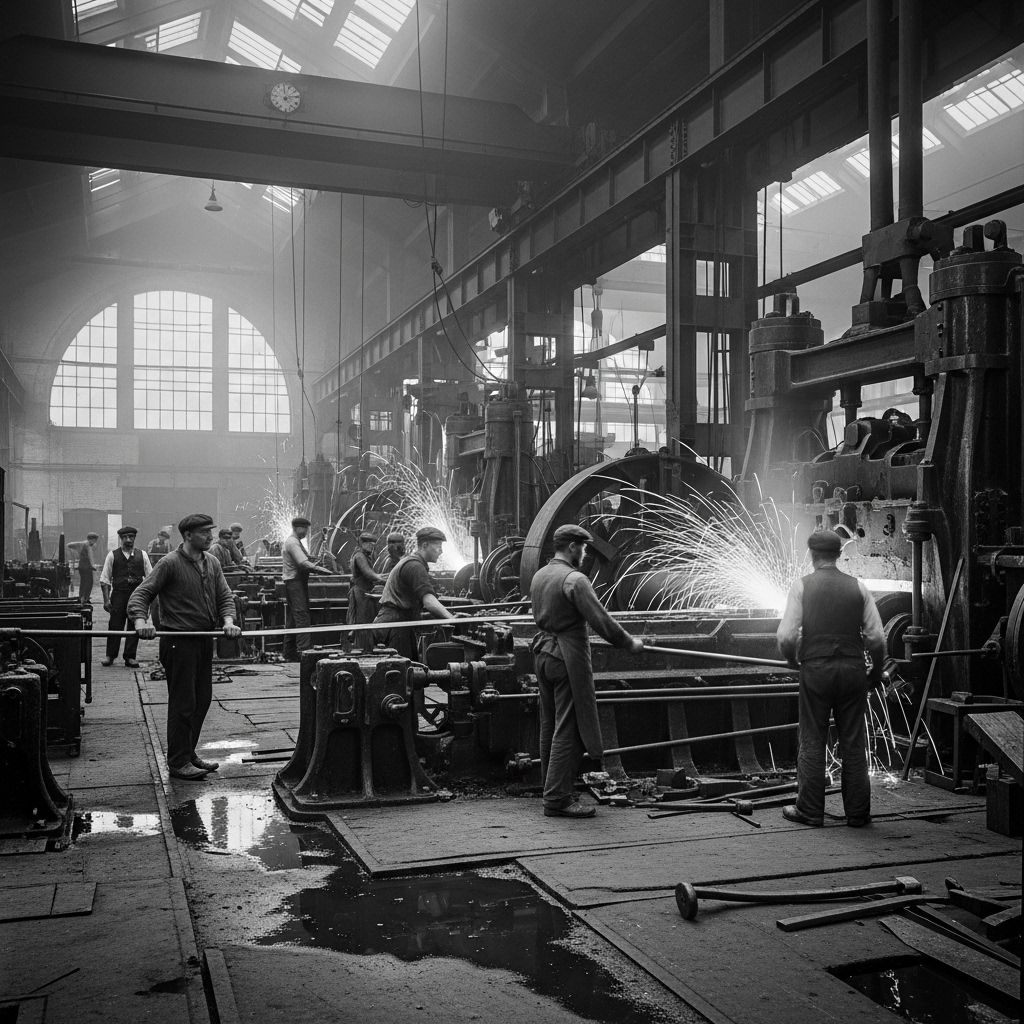
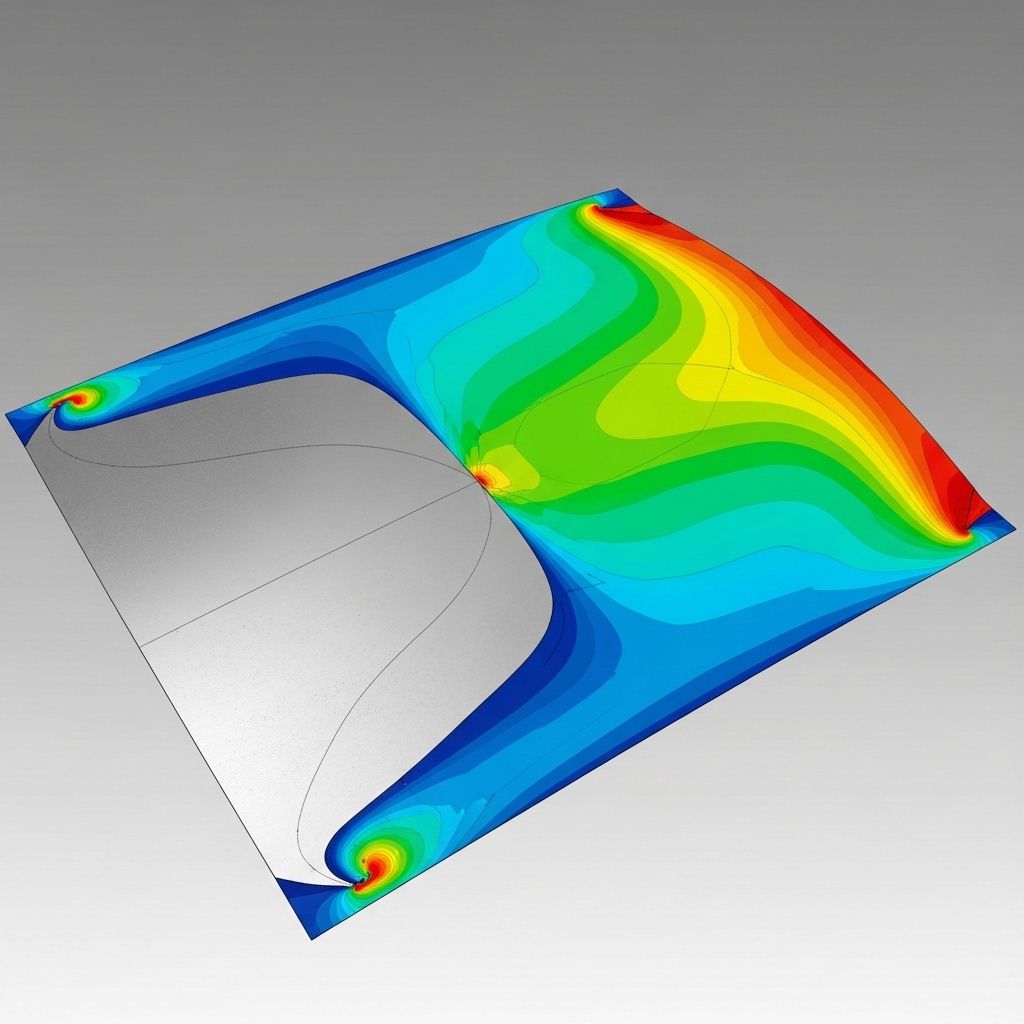
Residual stresses — internal stress fields that persist in the absence of external loading — are another dimension of molecular memory. Cold-forming processes such as deep-draw stamping and roll forming introduce substantial residual stresses into sheet metal panels. The distribution of these stresses, compressive in some regions and tensile in others, profoundly affects the component's response to subsequent loading and its susceptibility to stress corrosion cracking and fatigue crack initiation. Neutron diffraction and synchrotron X-ray techniques are employed in research facilities to map these three-dimensional residual stress distributions non-destructively.
Elastic Recovery and the Springback Problem in Forming
The elastic component of deformation is always present alongside plastic deformation during any forming operation. When a sheet metal blank is pressed into a die and the forming load is removed, the elastic strain component recovers, causing the formed component to partially spring back towards its original geometry. This springback phenomenon represents one of the most persistent challenges in precision sheet metal forming and is a direct consequence of the lattice's molecular memory for its elastic equilibrium state.
The magnitude of springback is determined by the ratio of yield strength to Young's Modulus (E) for the material: higher-strength steels, which are pressed with greater elastic strain components, exhibit more pronounced springback than mild steels at the same formed geometry. For advanced high-strength steels with yield strengths above 600 MPa, springback compensation routinely requires die geometry modifications of 3–12° of angular correction, determined through iterative finite element simulation and physical trial pressing. Aluminium alloys, despite their lower yield strength, also exhibit significant springback due to their lower Young's Modulus, which amplifies the elastic strain component at equivalent forming stresses.
Grain Boundaries and Their Role in Elastic Behaviour
Real metallic components are polycrystalline — they consist of many individual crystal grains, each with a different lattice orientation, separated by grain boundaries. These boundaries are regions of atomic disorder where the periodic lattice structure of one grain transitions to that of its neighbour. Their influence on elastic and plastic behaviour is significant.
Under elastic loading, grain boundaries contribute to the overall compliance of the material by allowing minor relative rotations between adjacent grains. Under plastic loading, they act as barriers to dislocation motion: a dislocation moving through one grain cannot simply continue into an adjacent grain with a different crystal orientation, and must instead pile up at the boundary, increasing local stress concentration until either new dislocations are generated in the adjacent grain or the boundary accommodates the strain through grain boundary sliding. This boundary-strengthening mechanism, known as the Hall-Petch relationship, describes the well-established observation that materials with finer grain sizes exhibit higher yield strengths: σ_y = σ_0 + k/√d, where d is the average grain diameter. Controlled rolling and thermomechanical processing exploit this relationship directly to produce high-strength automotive sheet steels without resort to expensive alloying additions.
Explore the physical consequences of these molecular mechanisms when automotive metals are subjected to concentrated loading — continue to the stress distribution physics article.